
Overview
TED launched TED Shorts publicly in May 2025, announced on 21 May and rolling out gradually since the beginning of that month, covered by TechCrunch alongside an official press release, both crediting Genuin as the technology partner.
TED wanted a TikTok-style short-form experience inside its own app, powered by its library of talks and original educational content, so it could grow engagement and own the audience rather than sending people to social platforms.
I owned the TED account on the Genuin side end to end, from the pre-sales demo through onboarding to a series of TED-specific product customisations that made the experience fit TED's brand, content model, and quality bar. TED ranked among the most heavily customised integrations we ran, and the more interesting part of the work was deciding which of those customisations deserved to become platform capabilities.
Who's involved
The global platform for ideas worth spreading, producing TED Talks alongside original podcasts, short video series, TED-Ed animated lessons, and TV programs translated into more than 100 languages, plus thousands of independently run TEDx events.
Visit TED →
A generative video experience infrastructure that lets brands embed scrollable, shoppable vertical video directly into their own websites and apps. Founded in 2021, reducing reliance on third-party social platforms by helping brands reclaim ownership of content, audience relationships, and data.
Visit Genuin →I worked with
Taking this feature live end to end meant working with some top product minds across TED's mobile app and web product.


- Pre-sales demo and brand walkthrough
- Requirement translation and customisation scoping
- Cross-platform coordination across web, Android, and iOS
- Analytics and measurement design
- Turning customer pain into roadmap proposals
Lifecycle owned: pre-sales demo, onboarding, production brand setup, Brand Control Center handoff, customisation negotiation, QA coordination, and launch.
Business Context
TED is the global ideas platform with a large library and a very large social following, but the app had been deprioritised for several years and had not seen a significant update in its fifteen-year history since launching in 2010. Its download momentum was slipping.
Per the TechCrunch coverage, the app was downloaded roughly one million times in 2024, down about seventeen percent from 1.2 million in 2023, against more than 100 million lifetime downloads, and the app hosts 26 podcasts across topics including business, climate, and health. TED's Head of Product is quoted in that coverage on how deprioritisation affected monthly active users and annual growth.
The strategic bet was to convert external social demand into an owned in-app short-form experience, on TED's own terms, at a moment when short-form video was booming and a major social platform faced a potential ban.
Own the engagement inside TED's ecosystem instead of renting it from social platforms.
The Product Problem
TED needed a branded, high-quality vertical video experience on its own surfaces that fit an educational content model and did not leak users or data away from TED.
- Brand and journey ownership vs. platform defaults: TED wanted shares to resolve on its own domain and did not want a generic shorts destination.
- Educational consumption vs. standard feed behaviour: TED wanted viewers to absorb the full gist of a talk, which pushed against default swipe behaviour.
- No redundant onboarding: TED's app already captured user interests, so the standard interest selection step was duplicative.
- Quality control vs. release velocity: TED is an extremely precise customer, sensitive enough that even a trivial change could trigger a full QA cycle on their side.
- Content-first discovery: TED is a content brand, but default search surfaced profiles and groups above videos.
Core friction: Every one of these tensions traded a platform default against something TED's brand or content model specifically required, and none of them had an off-the-shelf answer.
The Integration Surface
The integration covered a branded, white-labelled experience on TED's app and web, with share URLs resolving on TED's own domain; the swipeable AI-personalised vertical feed placed in the middle of the app's navigation bar; brand identity configuration in the Brand Control Center covering colours, nickname, and categories; analytics via a Mixpanel integration and TED-defined custom events such as video completion and funnel reporting delivered through SDK callbacks, plus a custom reporting dashboard; and a set of TED-specific SDK customisations across web, Android, and iOS.
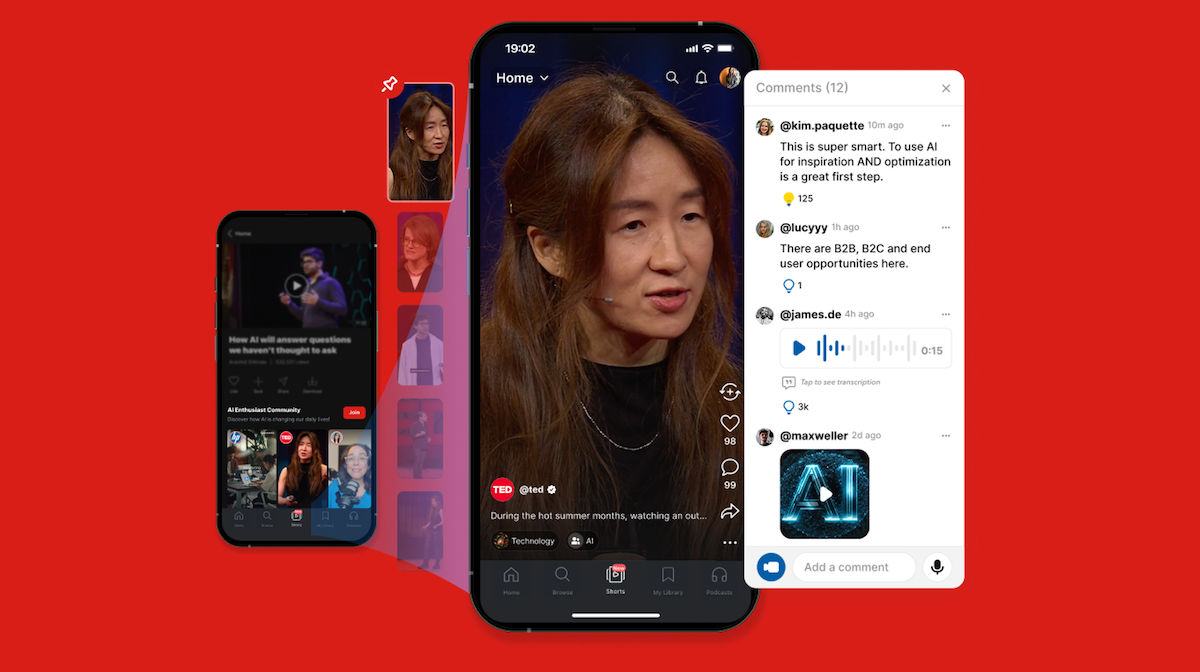
The public TechCrunch coverage independently confirms TED Shorts sits in the middle of the navigation bar, which matches the placement decision documented in our internal integration sessions, so the public record and the internal record line up.
The Six Customisations
The numbering is meaningful here: these were sequential asks over the life of the account.
- Share URLs resolve on TED's domain. Passing the same video ID or slug so TED can consume it and keep the user's journey inside TED's ecosystem rather than leaking to a generic platform link.
- The interest selection step removed. TED's app already captures interests on first open, so I had the popup removed and consumed TED's own interest data for feed personalisation instead.
- Auto swipe tuned for educational content. TED asked for this so viewers absorb the full gist of a talk.
- Custom login helper text. Consumers did not understand why a login or sign-up prompt appeared when they tried to act.
- A custom engagement dashboard, plus a Mixpanel integration. The dashboard compares two embeds on comments and watch time; TED defines the custom events the SDK fires so TED measures in its own tools.
- Cross-platform UI SDK detail screens. Coordinated across web, Android, and iOS so the experience stayed seamless, with platform-specific behaviours communicated to TED during QA.
Product Judgment Under Pressure
The auto swipe request is the one I want to be judged on. TED asked for a behaviour I did not think was right for a feed, and I said so. Auto advancing pulls control away from the viewer, and in most feed products that is a mistake.
But TED is not most feed products. Their content goal is comprehension rather than scroll volume, and a viewer who leaves halfway through a talk has not got the idea. I argued the case, lost it on the merits of their content model, and shipped it.
That is the pattern I would repeat: hold the opinion, put it on the record, then serve the customer. A product person who never disagrees is not adding judgment, and one who disagrees and then obstructs is not adding delivery. The record of the disagreement is what makes the decision reviewable later.
The strength of a product opinion is not whether it wins. It is whether it was stated clearly enough that the team could weigh it against the customer's actual goal.
Turning One-offs Into Product
An account with this many customisations becomes a maintenance liability if every fix stays bespoke, so the question I asked on each one was whether the underlying problem was a TED problem or a problem every content brand has. When it was the latter, I pushed for the fix to move into the platform.
Four worked examples, one of them still a proposal:
- Login helper text: built for TED because users did not understand the prompt, now generalised to all consumers.
- Reusable rendering: rendering parameters built for TED's web embeds, now generalised to the web SDK.
- Custom event tracking: TED defined the events it wanted fired via callback, now a repeatable capability.
- Configurable search: search defaulted to profiles over videos for content brands. This one is proposed and has not shipped. Stating that honestly matters more than claiming it did.
Cross-Company Alignment
This was a customer product integration, so most of the value was in aligning teams and functions across two companies. The named individuals I worked with most closely are covered above in "I worked with"; this section covers the teams.
TED Side
Genuin Side
Challenges & Trade-offs
| Challenge | How I Addressed It | Trade-off |
|---|---|---|
| Android hides the app's bottom tab when a community or group pill opens full screen, while iOS keeps tabs visible | Acknowledged as needing significant structural change and routed into a later design phase | Delayed platform parity |
| TED's precision means any change can trigger a full QA cycle | Careful change control and lightweight version variants | Slower release cadence |
| The redundant interest selection step | Removed and replaced by consuming TED's own interests | A per-customer customisation to maintain |
| Shares leaking to generic platform links | Custom share URL resolution on TED's domain | Another per-customer permutation |
| An auto swipe request I disagreed with | Delivered anyway to serve TED's educational goal, with the disagreement on the record | A feature shipped against my own preference |
| Search defaulting to profiles and groups over videos | Advocated for configurable ranking | The fix is a proposal, not a shipped default |
Key Learnings
- Fit the product to the customer's world. Removing the interest step and resolving shares on TED's domain are both about respecting the ecosystem the customer already built.
- Have a product opinion, and still serve the customer. Disagreeing on auto swipe and shipping it anyway are not in tension; the record of the disagreement is what makes the decision reviewable.
- Turn one-offs into platform value. The account stays maintainable when every fix is checked for whether it generalises.
- A demanding customer is a forcing function. TED's QA rigour improved the whole release process, not just their account.
Evidence & Sourcing
- TechCrunch coverage: independent confirmation of the launch, the navigation-bar placement, and the AI personalisation described above.
- Official press release: both sources credit Genuin as the technology partner.
The account ownership and the specific customisations described on this page come from the internal product and SDK sessions in which I am the attributed owner of the work.
Post-launch TED usage and revenue figures are not published here, because I do not hold cleared figures to share. The pre-launch context numbers reported by TechCrunch describe the opportunity rather than the results, so they are deliberately not presented as impact metrics.