
Overview
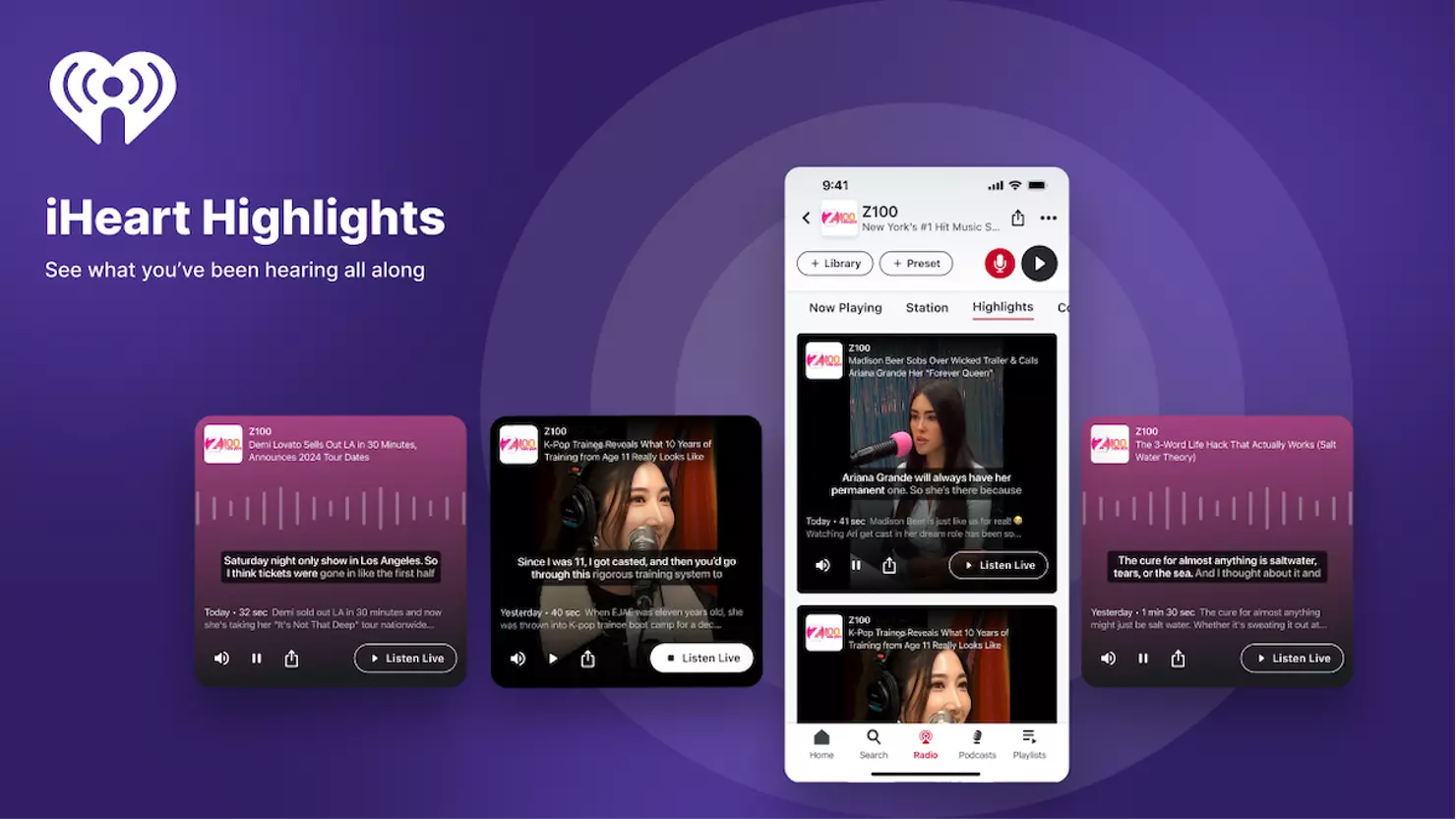
iHeartMedia is the largest audio company in the United States. It owns a massive library of talent-driven audio, but the discovery, engagement, and monetisation energy of short-form video was happening on social platforms it does not own. The goal was to bring that experience inside iHeart's own ecosystem so iHeart keeps the audience, the first-party data, and the monetisation instead of renting all three.
The feature launched publicly as iHeartRadio Highlights, powered by Genuin, in the free iHeartRadio app in November 2025. Clips flow in from an AI clipping pipeline called Overlap that turns long-form audio into vertical video. This is confirmed in production because the integration's own data payloads stamp the clip source as Overlap.
Who's involved

The largest audio company in the United States, operating broadcast radio stations, podcasts, and the iHeartRadio app.
Visit iHeartMedia →
A video experience infrastructure company that lets brands embed scrollable, shoppable vertical video directly into their own web and app properties, so they keep the audience and the first-party data instead of sending people to social platforms.
Visit Genuin →
An AI clipping tool that turns long-form audio into short vertical video clips. It is the source of the Highlights clips, confirmed in production because the integration’s data payloads stamp the clip source as Overlap.
Visit Overlap →I worked with
Taking this feature live end to end meant working with some top product minds on the customer side.

- Translated iHeart's product, engineering, analytics, and legal requirements into a working integration
- Owned content & ad pipeline, analytics architecture, branded communications, and white-label setup
- Designed the privacy-by-design data separation architecture
- Specified the full outbound communications matrix (51 triggers)
- Led cross-company alignment across six workstreams
Business Context
iHeart's talent roster generates massive audio content daily, but short-form video engagement was flowing to social platforms where iHeart rents audience, data, and monetisation rather than owning them. The strategic imperative was clear: build a first-party short-form video experience inside iHeart's own ecosystem.
I was the product owner and customer integration lead on the Genuin side. My job was to translate iHeart's product, engineering, analytics, and legal requirements into a working integration covering the content and ad pipeline, the analytics and event-streaming architecture, the branded outbound communications, and the white-label and deep-link setup.
The Product Problem
The problem had four tensions to resolve at once:
- Engagement vs. ownership: iHeart wanted the reach and feel of social vertical video but on its own surfaces with its own first-party data.
- Rich analytics vs. content privacy: Detailed per-user, per-video measurement is exactly what content-privacy law restricts. The integration had to deliver deep measurement without ever creating a record linking a specific user to the specific video they watched.
- Monetisation vs. experience: Sponsorship and programmatic revenue had to feel native inside the feed rather than intrusive.
- Branding vs. platform defaults: Every consumer touchpoint (email, push, subdomain, share links) had to appear to come from iHeart, which introduced real deliverability and DNS constraints.
Core friction: The more precisely we measured, the more legally exposed the customer became, and every obvious solution traded one requirement away for the other.
How It Works
At a glance: how a clip gets from Overlap to a listener's feed, and how engagement flows back without ever identifying who watched what.
Integration Scope
The integration spanned six workstreams I owned end to end:
- Content pipeline: The SDK requests video and receives the clip plus its metadata, rendering it on station and podcast pages.
- Monetisation & ad pipeline: Sponsored posts, sponsored takeovers, and programmatic audience extension through iHeart's Triton ad server via the IMA SDK.
- Analytics & event streaming: A three-layer event taxonomy with SDK events, iHeart codebase events, and video metadata attributes.
- Data privacy architecture: Structural separation of user-level and video-level data at emission with no shared key.
- Branded outbound communications: 27 email triggers and 24 push notification triggers covering the full community lifecycle.
- White-label & deep-link setup: Branded subdomain, sender email white-labeling, and deep-link activation with AASA for iOS and assetlinks.json for Android.
Privacy as Architecture
This is the flagship piece of the integration and deserves the most space. The defining decision was to make privacy a structural property of the system rather than a policy bolted on top.
User-level data and video-level data are separated at the moment the SDK emits them, written to separate stores with no shared key, and delivered as two independent datasets with no join key. The result is that no record anywhere links a specific user to a specific video, and that separation is architectural rather than a promise.
Key insight: Legal teams cannot approve a promise, but they can approve a schema. Once the separation lived in the architecture rather than in an access policy, four different iHeart teams could sign off on one document.
Event Taxonomy
The event taxonomy spans three layers:
- Genuin SDK events: placement initialised, placement viewed, placement maximised, video started, impression, quality view (3s), quartile milestones, video complete, and linkout viewed.
- iHeart codebase events: session start/end, track start/end, play, pause, share, screen and page view.
- Video metadata attributes: id, duration, aspect ratio, category/topic, slug, transcript, and ML embeddings.
Identity Resolution
Specific identifiers are withheld by design: device ID is not passed in the video request payload, and station and episode identifiers are stripped from the ad request payload. Identity resolution uses:
- Fingerprinted UUID for non-logged-in web
- Persistent brand user ID on login
- IDFA on iOS (only with tracking consent)
- GAID on Android
- Cookie sync on consent
All confined to the user-level store.
Unified Amplitude Proposal
iHeart configures credentials once and both streams arrive independently: one pipeline instead of fragmented silos, no duplicated engineering on iHeart's side, real-time plus historical analysis, phased rollout, and full data ownership on iHeart's side with Genuin acting as transport.
Content & Ad Pipeline
The content and ad pipeline runs in five steps, with privacy controls applied at every stage rather than filtered downstream.
This pipeline supports sponsored posts, sponsored takeovers, and programmatic audience extension, all with privacy controls baked in at the payload level rather than applied as an afterthought.
Branded Communications
I specified the full outbound matrix: 27 email triggers and 24 push notification triggers, each mapped to its trigger surface, trigger action, and exact recipient, covering the community and group lifecycle plus social interactions, with the notification copy written out.
I also drew the proof-of-concept boundary explicitly, disabling specific triggers such as creator access and repost notifications so the first version stayed focused.
Two real deliverability blockers surfaced:
- The platform's mail provider will not send from no-reply addresses. I recommended a compliant sender identity.
- iHeart's own DMARC policy would have silently blocked the branded mail. I provided DMARC guidance and an SMTP alternative for full client control.
Product Decisions
- Making privacy structural rather than procedural. Separating the two data classes at emission with no join key is what let legal review a design instead of trusting a policy.
- Withholding specific identifiers. Deciding exactly which fields to strip from the video request and ad request payloads was a precise product and legal call, not a blanket rule.
- Unifying the analytics pipeline into Amplitude. One connector configured once: less duplicated engineering, easier compliance auditing.
- Scoping the proof of concept deliberately. Disabling specific notifications kept the first version focused.
- Using placements over embeds. iHeart's station and podcast surfaces need multiple styles, multiple sections, and linkouts, which embeds cannot express.
- Recommending a compliant sender identity and DMARC policy. This replaced a no-reply default and is what made branded mail actually deliverable.
Cross-Company Alignment
This was a customer product integration, so most of the value was in aligning teams across two companies.
iHeart Side
Genuin Side
Challenges & Trade-offs
| Challenge | How I Addressed It | Trade-off |
|---|---|---|
| Content privacy restricts linking users to videos | Data separation architecture and withheld identifiers | Analyses needing a user-to-video join are impossible by design: the intended cost |
| Mail provider blocks no-reply senders | Compliant sender identity plus DMARC guidance | Requires iHeart to create the address and adjust DNS |
| Duplicated analytics engineering across silos | Single unified pipeline with a one-time connector | Genuin becomes the transport dependency for iHeart's analytics |
| Trying to ship everything at once in the PoC | Explicit scoping: disabling specific triggers | Some features deferred to post-launch |
| Embed vs. placement confusion | Chose placements and documented the distinction | Placements are more complex to configure |
Key Learnings
- Turn constraints into architecture. Making privacy structural rather than a policy on top is repeatable for any regulated integration.
- A customer integration is a multi-team alignment problem. The real work was giving legal, product, analytics, and engineering across two companies one design they could all agree on.
- Specify exhaustively, then scope deliberately. Writing out all 51 triggers before deciding which to disable gave the scoping decision a real foundation.
- Documentation is leverage. The integration playbook turned this account into a template for the next one.
Evidence & Sourcing
- iHeart launch announcement: public confirmation of the feature launch.
- iHeart blog post: "See What You Hear" editorial on Highlights powered by Genuin.
The launch names marquee shows including The Breakfast Club, Elvis Duran and The Morning Show, The Bobby Bones Show, Las Culturistas, and Are You A Charlotte.