
The Observation
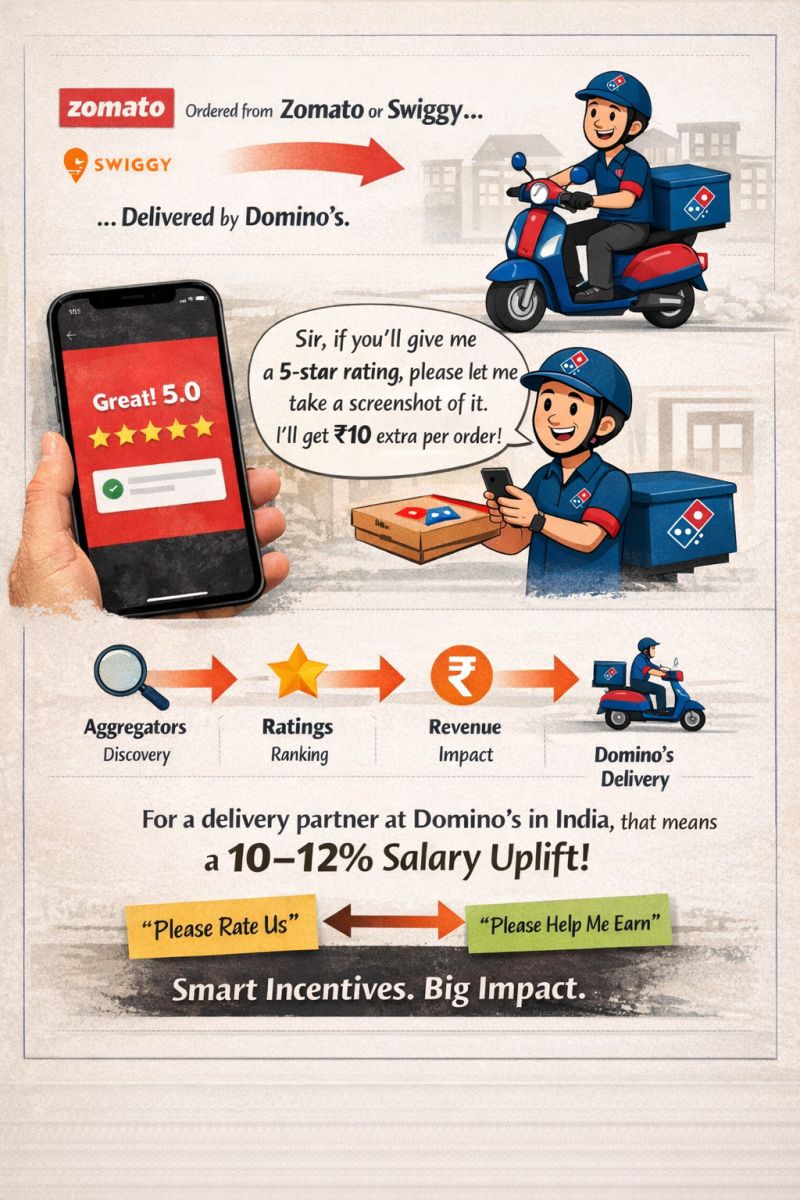
A routine Domino's order placed via Zomato turned into a fascinating micro-interaction at the doorstep. After delivery, the Domino's delivery partner made an unusual request:
"Sir, can you give a 5-star rating to the restaurant and this order? Can I take a screenshot of the rating? I get ₹10 extra per order if I submit it."
This wasn't a generic "please rate us" nudge. It was a performance-linked incentive operating at the last human touchpoint — entirely outside the aggregator's product surface.
The Insight
Here's the supply chain dynamic most users don't think about: even when you order Domino's through Zomato or Swiggy, the delivery partner is still from Domino's. Unlike most restaurants that rely on aggregator fleets, Domino's has always positioned itself as a delivery-first company. They own the last mile.
This creates a unique power structure in the marketplace:
- Aggregators control discovery and user acquisition
- Ratings control ranking within the aggregator platform
- Rankings directly control revenue and order volume
- Domino's controls the delivery — the final moment before a rating is given
Primary Insight: By owning the delivery channel, Domino's has a privileged position to influence the one metric that aggregators use to rank restaurants — ratings. They turned their delivery fleet into a distributed ratings acquisition system.
The Problem
For QSR brands operating on aggregator platforms, platform dependency is the core friction. Ratings directly impact search ranking, and ranking directly drives order volume. But brands have limited control over the rating experience — aggregators own the app UI, the notification system, and the review prompt flow.
Core Friction: Aggregator platforms control discovery and ranking, but QSR brands have no native lever to influence the rating conversion rate — except at the physical delivery moment.
The Concept
Doorstep Behavioral Nudge — The ₹10 Screenshot Incentive
Domino's designed a remarkably simple incentive layer: delivery partners earn ₹10 per verified 5-star screenshot. No API integrations. No platform dependency. Just pure behavior design at the doorstep.
This reframes the request from a generic "please rate us" notification to a personal, human moment — "please help me earn." The emotional reframing is what changes the conversion rate.
Let's look at the economics:
- Average metro deliveries per shift: 18–25 (high-density zones)
- Working days per month: ~22, totaling roughly 400–500 deliveries/month
- Baseline assumption: 450 deliveries/month
- 40% 5-star conversion rate: ~180 eligible screenshots
- Additional monthly earnings: 180 × ₹10 = ₹1,800+ per month
For a delivery partner earning around ₹12,000–₹18,000 base (varies by city and incentives), ₹1,800 represents a meaningful 10–15% performance-linked upside. That's significant enough to drive consistent behavior change across the fleet.
Expected Impact
This growth loop creates a multi-layered impact:
- Higher ratings → improved search ranking on Zomato/Swiggy
- Better ranking → increased organic order volume (without ad spend)
- Delivery partner incentive → higher fleet motivation and lower attrition
- Zero platform dependency → no API changes, no aggregator approval needed
The cost per rating is trivially low (₹10), but the revenue impact of improved ranking on a platform processing millions of orders daily is disproportionately high. It's a high-leverage, low-cost growth hack that compounds over time.
The Takeaway
Sometimes the smartest growth loops don't live in code. They live at the last human touchpoint.
This is a masterclass in behavioral design at the intersection of marketplace dynamics and last-mile operations. Domino's didn't need to integrate with aggregator APIs, build a rating prompt system, or invest in complex technology. They simply identified the moment of highest emotional receptivity — a face-to-face delivery interaction — and designed a micro-incentive around it.
For product thinkers, this pattern is worth studying: not every growth lever needs to be a product feature. Sometimes it's a process change operating at the behavioral layer — outside the product surface entirely.